
Google AI Max for Search: Wins, Wobbles, and How to Test It Safely
Discover how to test Google AI Max for Search safely. Our 3-phase framework covers query expansion, URL controls, and brand…

Read time3 mins

By Mike Sharp, Operations Director, Launch
I have referred to this many times over the last year. Back in 2015 I made a bold and somewhat ridiculed prediction that the website could be on its last legs.
Turns out I was only about 10 years early.
The data from Google this week shows that my prediction is coming into fruition.
Not only does the Gemini App have over 1 billion users actively making use of the app each month, it’s officially Google’s fastest growing product in the company’s history.
And the growth of AI apps isn’t limited to Google, back in May ChatGPT announced it had hit the same 1 billion mark.
The raw user count is not the interesting story here, impressive as it is, it is how people are using it that marketers should take note of.
The latest data shows 63% of Gemini interactions are now voice. Not to blow my own trumpet, but voice search was another of my predictions back in the day.
One in five Gemini Live interactions involve live camera feeds or screen sharing. On IOS, Gemini has now crossed 100m active users and macOS power users are prompting twice as much as people on other devices.
Between voice searches, live camera problem solving and tools (which I can’t now live without) the traditional web browser is getting bypassed more and more. Take for example Circle to Search which lets you highlight anything on your screen and search it.
We are now in the age of simply pointing your phone at your broken dishwasher and letting AI tell you what to do!
While all of this is happening, we are also seeing AI split into 3 clear directions:
We have seen Google pushing away from manual controls for a long time. AI Max is just the next natural step towards automated text generation, URL expansions and broad intent matching.

Data suggests people are using ChatGPT as a main assistant, Claude for technical tasks and Gemini across the Google environments.
For paid media agencies it’s now much less about which AI model is winning. That is the wrong question entirely. It’s how you get visibility across this new fragmented ecosystem.
The customer journey is even messier in the middle, breaking into voice, screen gestures (i.e., Circle to Search), image searches and ad supported AI conversations. All running across different parts of the buying cycle.
You have to be discoverable (the new buzzword) and you have to be wherever the answer is generated.
This means structured data, optimising for AI discovery and making sure you have good data you can feed into the automated campaign types as the platforms take more control.
My prediction is still wrong (even though it’s closer) as the traditional website won’t disappear overnight.
However, standard search-only strategies will become more obsolete as the AI evolution continues exponentially.
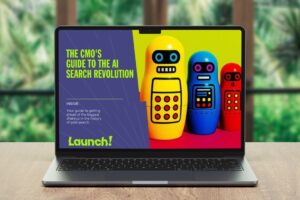
And we’ve written a white paper about it. You can access the CMO’s Guide to the AI Search Revolution here.
With 15 years of experience in marketing and operations, Mike brings a unique perspective on efficiency and leadership. Before Launch, he worked at full-service agencies in Bristol, delivering for a wide array of clients. At Launch, Mike is dedicated to empowering teams, ensuring they have the support, tools, and processes needed to perform at their best and deliver excellence.
Discover how to test Google AI Max for Search safely. Our 3-phase framework covers query expansion, URL controls, and brand…

Traditional search is fracturing, and operating SEO and PPC in isolated silos is rapidly becoming unsustainable. Here's how Marketing leaders…
Launch's guide is a blueprint for growth in the age of AI search.