
Google AI Max for Search: Wins, Wobbles, and How to Test It Safely
Discover how to test Google AI Max for Search safely. Our 3-phase framework covers query expansion, URL controls, and brand…

If your paid media and organic search teams are operating in isolation, your ecommerce brand is actively leaking Google Shopping revenue.
Historically, the Merchant Center feed has lived exclusively with paid teams, kept at arm’s length from organic search strategies.
But this disconnect could lead to commercial vulnerability. Google Shopping relies on an interconnected data framework where on-page SEO content directly influences paid performance, free listings visibility, and future AI search readiness.
When these channels are siloed, performance plateaus. Paid teams spend valuable hours rewriting titles and appending metadata inside feed management tools, but those improvements never reach the actual website.
The website content remains static, leaving the organic search team blind to high-performing data assets.
To scale effectively ahead of the peak Q4 season, brands must establish a single source of truth for their product data.
Optimisation shouldn’t begin in the feed tool. True efficiency starts when product sheets are enriched and centralised before the data ever splits into individual marketing channels.
If your brand runs on Shopify, make sure you’re utilising meta fields effectively. The intention is not to clutter the visible product page, but to house critical specifications in a structured location that both PPC and SEO frameworks can pull from simultaneously.
Building a connected workflow removes the grey areas around data ownership. When backend data is accurate from the source, it establishes a high-performing baseline for free listings, paid campaigns, affiliates, and social catalogs.
Achieving a significant jump in organic shopping visibility requires focus on three interconnected areas:
| Pillar | Focus Area | Impact |
| 1. Product titles | Logical structures enriched with specific intent data (brand, product type, key attributes). | Maximises visibility for non-branded, high-intent search queries. |
| 2. Product schema | Complete structured data with minimal errors, fully reflecting your active feed structure. | Eliminates indexing barriers and unlocks eligibility for enhanced free listings. |
| 3. Feed-to-Page Consistency | Identical alignment between the merchant feed, on-site text, and structural data. | Mitigates the risk of feed disapprovals and sudden drops in account visibility. |
Standard out-of-the-box CMS integrations often miss the deeper attributes that search engines use to categorise products.
High-growth brands should actively enrich their structured data with:
Uncovering the most effective structure for your Google product listings requires a solid testing methodology. Titles must communicate clear intent before reaching the character limit cutoff, as users rarely see data trailing past the first 80 to 90 characters.
Examples:
[Brand Protection Focus] → Brand + Product Type + Model + Variant (Colour/Size)
[Non-Brand Acquisition] → Core Keywords + Product Type + Model + Brand
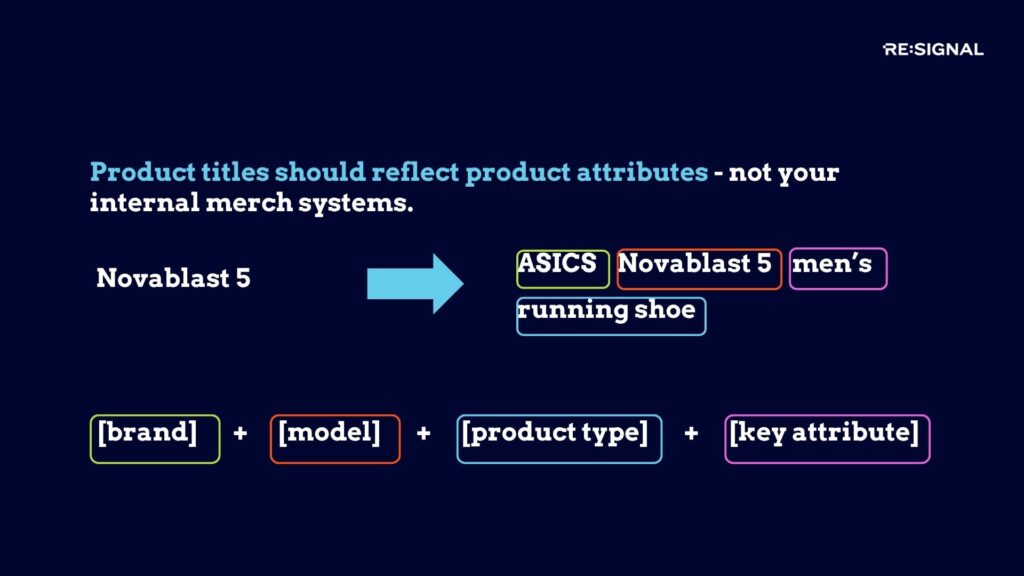
Avoid industrial formatting or internal merchandising jargon. Explicitly writing the word ‘Size’ before a value (e.g. ‘Size 10’) wastes valuable character space. Algorithms and consumers understand structural attributes when formatted cleanly.
Contrary to conventional wisdom, leading with your brand name can be counter-productive. If your brand is not an established household name, front-loading descriptive, non-branded keywords leads to higher click-through rates. Google’s shopping interface automatically adds the merchant name to the listing anyway.
Run title variation tests over a minimum period of four to six weeks to collect mathematically sound conversion metrics.
More detail on how to test and title your paid shopping feed listings is available in our blog The CMO’s 2026 Guide to Shopping Feeds: From Technical Hygiene to Growth Intelligence.
Clean, unified product data matters beyond immediate campaign efficiency. Traffic distribution in the e-commerce landscape is shifting. Previously, category pages held primary organic value. Now search engines are increasingly prioritising Product Detail Pages (PDPs) and direct interactive interfaces.
AI search engines and smart assistants are changing how people shop. Instead of users clicking through to your website, agents will scrape product details straight from your backend data feeds to compare prices, colours, and stock levels right there on the search page.
If your product data is incomplete or disorganised, these agents simply won’t know you exist, risking your brand getting dropped from the consideration list before a human shopper ever has the chance to see you.
By fixing your data foundations now, you are buying brand visibility in the zero-click environment, securing your performance stability long before the high-pressure peak season begins.
If you suspect your paid and organic channels are burning budget on the same metadata corrections, let’s look at the source data together. Book a strategy diagnostic call with our team to move beyond campaign reports and unlock actual growth intelligence.
You can also get detailed information on how to configure your Google Shopping Feed for growth in our blog.
Callum Lockwood is Director of Organic Search for Re:Signal. He has been involved with search engine optimisation since 2010, working with clients in both B2B and B2C environments. Callum’s main focus is technical & on-page SEO as well as bringing UX experience to the Re:signal team.
Connect with Callum on LinkedIn.
Danny Ireland is Head of Paid Media for Launch. Danny has 10+ years experience helping brands drive growth from their performance marketing. After a significant time working for Google, he joined Launch and heads up our Paid Media expertise. He oversees the planning, build, and execution of client’s global paid strategies to help our clients reach their north star objectives.
Discover how to test Google AI Max for Search safely. Our 3-phase framework covers query expansion, URL controls, and brand…

Traditional search is fracturing, and operating SEO and PPC in isolated silos is rapidly becoming unsustainable. Here's how Marketing leaders…

Launch's guide is a blueprint for growth in the age of AI search.