
Breaking the Silos: why E-Commerce Discoverability Depends on Joined-Up Paid and Organic Search
Traditional search is fracturing, and operating SEO and PPC in isolated silos is rapidly becoming unsustainable. Here's how Marketing leaders…

Senior marketing leaders are under relentless pressure to stretch paid media budgets further while justifying every pound to the board. When Google promises that enabling AI Max for Search delivers a 14% uplift in conversions, skepticism is a healthy, natural response.
The concern among CMOs is clear: will letting AI take control compromise brand messaging, waste budget on irrelevant search queries, or direct high-intent traffic to outdated website pages?
At Launch, our paid media team has been running structured 50/50 split experiments with AI Max for Search across scaling DTC and e-commerce accounts.
Here is what we are seeing in the wild, what the data actually tells us, and how to test the feature without burning cash.
People no longer search in two-word fragments like “Portugal holiday”.
They ask full, complex questions on their phones. Searches eight words or longer have surged, and 15% of daily Google queries are entirely new.
Populating accounts with every possible exact-match keyword is no longer feasible. Google designed AI Max for Search to address this reality. It operates as an enabled feature within existing search campaigns, built to replace Dynamic Search Ads (DSAs) ahead of their deprecation.
Instead of relying solely on keywords in your account, AI Max connects user intent signals across browsing history and audience data. A user searching for “best housewarming gift” might see an ad for an espresso machine because Google recognises their broader buying journey.
Performance results across client accounts are case-dependent. We have seen clear winning campaigns alongside tests that returned neutral or flat results.
Treating a flat or neutral result in an early experiment as a win is the right strategic mindset.
When Broad Match and Performance Max were first introduced, initial performance across the industry was mixed before algorithmic models matured. A flat result in an AI Max test means you are capturing broader intent and future-proofing your account structure without losing commercial efficiency.
Results can also vary within the same account across different timeframes due to seasonality or specific landing page triggers.
That level of variability makes structured, isolated testing essential.
Enabling AI Max across an entire account without guardrails creates unnecessary risk. The safest approach is running a 50/50 split experiment and rolling features out in three distinct phases.
Enable AI Max to expand query reach based on user intent while keeping text customisation and final URL expansion switched off.
Guardrail: Apply direct negative keywords. If you are a luxury brand, exclude “cheap”. If you sell dog food, exclude “cat”. Be careful not to over-filter search terms that indicate genuine intent.
Allow AI Max to adapt headlines and descriptions based on user context.
Guardrail: Set term exclusions and use messaging restrictions. You can add up to 40 prompt-style instructions telling the system what to avoid (for example: “Never use the word cheap or affordable because we are a luxury brand”). Avoid adding so many restrictions that you choke the algorithm’s ability to test and learn.
Permit AI Max to direct users to the most relevant page on your website based on their search signals. Guardrail: Apply strict URL exclusions.
Block legacy blog posts, outdated content hubs, and irrelevant product categories to ensure traffic lands on high-converting pages.
AI Max delivers the strongest returns when paid media strategy connects directly with web and content teams. When AI Max generates high-performing headline variations or surfaces unexpected landing page combinations, feed those insights back to your conversion rate optimisation (CRO) and copy teams. High-converting ad text created by AI can inform website messaging, while top-performing landing pages highlight where content investment is paying off.
Treat AI Max as one component of Connected Performance: uniting experimentation, media management, and measurement to drive sustainable growth. Need help navigating AI Max?
If you want to understand how AI Max fits into your current search strategy, our team can help you build structured 50/50 experiments with proper guardrails.
Get in touch with Launch to set up a discovery conversation.
Traditional search is fracturing, and operating SEO and PPC in isolated silos is rapidly becoming unsustainable. Here's how Marketing leaders…
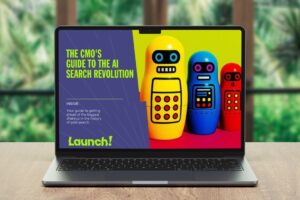
Launch's guide is a blueprint for growth in the age of AI search.

Is last-click attribution stalling your growth? Launch CEO Jaye Cowle reveals why ads aren't always the answer and how measurement…