
Google AI Max for Search: Wins, Wobbles, and How to Test It Safely
Discover how to test Google AI Max for Search safely. Our 3-phase framework covers query expansion, URL controls, and brand…

Read time5 mins
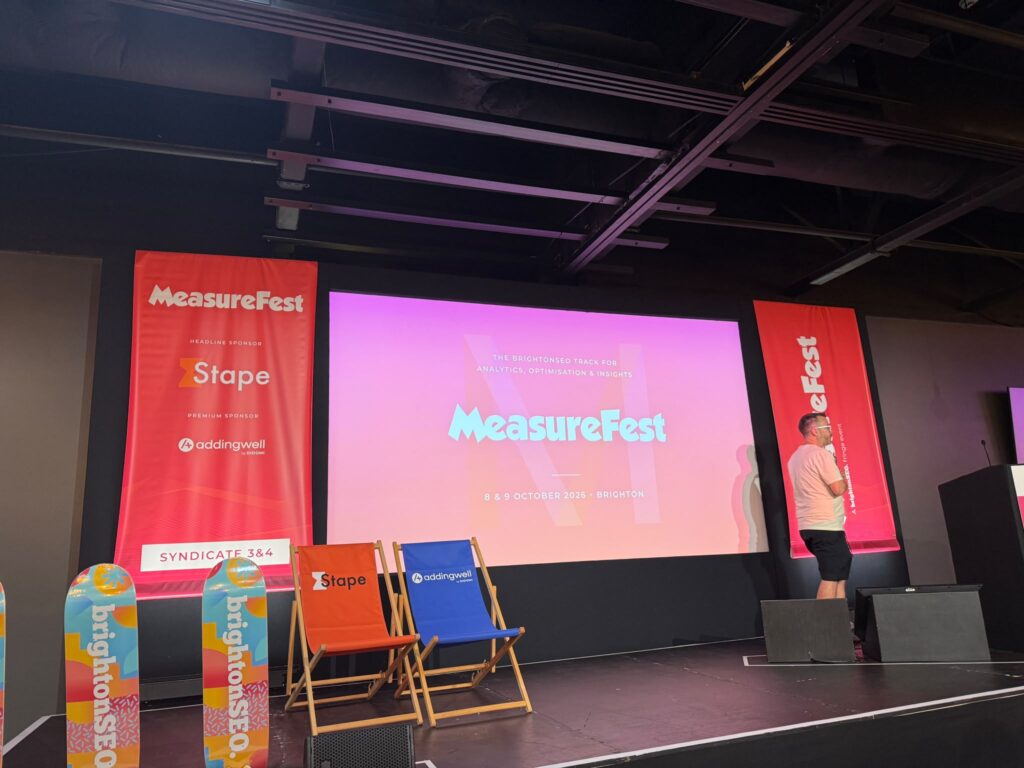
When I took to the stage at BrightonSEO and MeasureFest, I wanted to issue a call to arms for data analytics and marketing teams. For over a decade, performance marketing has been hooked on the promise of a single source of truth – a perfect Google Analytics dashboard where you know where every £1 has been spent and which channel returned the best ROI.
We’ve made it worse for ourselves as agencies and in-house teams have delivered monthly dashboard to marketing directors and CFOs showing them oversimplistic easy to measure KPI’s without educating them on the things that are important but that we can’t measure!
The reality is that in today’s fragmented digital environment, a single source of truth simply does not exist. Audits of major brands spending over 95% of their ad budgets on bottom-of-the-funnel brand search terms expose how dangerous this reliance is. Capturing existing demand is constantly being prioritised over creating new demand – the easy to measure over the hard to measure. We know not everything in marketing can be directly tracked but we need to admit it out loud and educate the purse string holders to unhook from this myth so we can deploy budgets to deliver true commercial growth over short term ROAS.
The Launch team have penned this last-click attribution problem as the “Harry Kane effect”. Just like a star football striker taking 100% of the credit for every goal, last-click models assign all conversion value to the final touchpoint, ignoring every pass, strategy, and team effort along the way.
Tracking multi-device consumer journeys has become increasingly broken due to first-party signal loss and third-party cookie deprecation. At the same time, the rise of AI overviews and zero-click search is creating a perfect storm. Recent Ahrefs data reveals that organic clicks fall by 58% in top search results when an AI overview appears, and only 1 in 100 users actually clicks inside an AI summary link.
This shift comes during tough economic conditions where rising interest and mortgage rates leave households feeling worse off so revenue is harder to come by, especially for DTC brands and it’s having the impact of reducing marketing budgets forcing teams to have to do more with less.
You may have heard this before, that the funnel is dead and it’s true, modern customer journeys operate in a multi directional path to purchase with streaming, scrolling, searching and shopping appearing in the journey of evaluation and consideration. This can feature influence points across dark social, WhatsApp groups, Reddit, and word of mouth that standard tracking finds almost impossible to measure. The 4’s was coined in Research by Boston Consulting Group (BCG) and Google and it highlights that brands need to mature their understanding of the path to purchase that their customers take by building influence maps and overlaying behavioral personas to understand how purchase decisions are actually made.
Over-indexing on bottom-of-funnel last-click channels traps brands in what WARC calls the ‘doom loop’ or performance plateau. It’s cited that last-click attribution overestimates the true impact of paid search by up to 190% – the ‘Harry Kane effect’ damaging the potential for growth by misleading marketing teams reading the data.
Paid search does not create search demand on its own; in fact, 30% of paid search quotes are directly generated by untracked marketing channels (according to research by the Direct Marketing Association). Being highly efficient on paper does not mean a business is primed for growth. Over-optimising for short-term efficiency depresses total net incremental profit. Binet and Field’s research confirms that optimal effectiveness requires balancing 60% brand building with 40% sales activation. Yet under economic pressure, brands frequently cut brand building as fluffy, starving future demand generation.
To break through performance plateaus, marketing teams must adopt a modernised, four-step measurement framework:
1. Fix Data Foundations: Audit GTM tags, deploy server-side tracking, and utilise enhanced conversions to secure privacy-first signal collection.
2. Map Customer Journeys: Collaborate with consumer insight teams to map influence maps and account for untracked touchpoints.
3. Ditch ROAS for MER: Shift away from bottom-of-funnel ROAS and adopt Marketing Efficiency Ratio (MER) to evaluate holistic marketing impact.
4. Prove Incrementality & Deploy Econometrics: Execute regional GEO holdout tests to measure net incremental lift, and deploy Marketing Mix Modeling (MMM) econometrics, which is now accessible for mid-market brands via open-source tools like Google Meridian.
Shifting from demand capture to active demand generation delivers clear commercial results. Our client, luxury candle and home fragrance brand St Eval, was historically hooked on standard ROAS metrics and heavy search activation.
As their growth partner, Launch challenged St Eval to flip their strategy ahead of peak season, investing heavily in brand-building demand generation well before peak demand hit. The strategy was transformative: building brand demand expanded category interest, which simultaneously lifted paid search revenue alongside overall growth. St Eval achieved a £7.50 return for every £1 invested in brand building. Robust incrementality measurement gave the CFO and board the confidence needed to scale media budgets weekly.
You can read the full case study here – also featured in Performance Marketing World.
Educate executive leadership that attribution is an imperfect decision tool and needs to be developed into a more mature influence map to understand what is being measured and what can’t be measured but is still important.
Rebalance media spend toward Binet & Field’s 60/40 brand-to-activation ratio to generate long-term demand.
Mature your marketing measurement and undertake a technical audit on GTM tags, server-side tracking, and privacy settings with Launch’s data and measurement team.
Validate ad platform claims through holdout experiments and experimentation frameworks to measure true net-incremental profit.
Jaye Cowle is the CEO and Founder of Launch, a performance marketing agency leading commercial growth and media innovation. Named in the 2026 PMW Powerlist, Jaye leads Launch’s data-driven strategies, driving achievements including a 79 Client NPS, Google Premier Partner status, and 24% revenue growth. Jaye’s core focus is driving commercial growth and performance innovation by aligning performance marketing and brand strategy, and she is a regular speaker at major industry events including HeroConf, BrightonSEO, and MeasureFest.
Discover how to test Google AI Max for Search safely. Our 3-phase framework covers query expansion, URL controls, and brand…

Traditional search is fracturing, and operating SEO and PPC in isolated silos is rapidly becoming unsustainable. Here's how Marketing leaders…

Launch's guide is a blueprint for growth in the age of AI search.