How Our Connected Performance Approach is Driving Award Winning Growth for Our Clients
Launch has been shortlisted for the UK Agency Awards 2026, hot off the winning Performance Marketing Agency of the Year…
Social and tech platforms are continuing to evolve exponentially as – like any other business – they search for ways to increase (and retain) unlocked revenue and drive business growth.
The latest is Meta.
TechCrunch was one of the first to drop the news last week that the tech company is trialling premium subscriptions for its social platforms – Instagram, Facebook and WhatsApp in the UK. The full details are – at the time of publishing this blog – to be confirmed. But it’s got the industry talking.
What we know so far is that the core functionalities of each social platform will remain free. Additionally, this is not an extension of Meta Verified – launched in 2023 for creators wanting a blue tick.
Instead, Meta is testing the viability of launching a premium subscription service that, in its own words, will ‘unlock productivity and creativity’ as well as aid users to take advantage of current and emerging AI capabilities. It, in part, aligns with the ad-free service Meta launched in the EU two years ago and will potentially cost users up to £3.99 per month.
The potential features of this elevated and paid-for offering will include an ad-free social experience, as well as access to extra features and expanded AI tools such as Vibes (Meta’s video generation tool) and Manus, the AI company it bought for $2bn in December 2025.
For Instagram specifically, users will be offered unlimited audience lists and the ability to see who doesn’t follow them back, as well as anonymous story viewing.
It’s certainly not a new concept.
We’ve seen a very similar premium subscription offering – in terms of ad-free – being introduced by streaming services such as Netflix and Amazon Prime. Again, designed to offer an enhanced customer experience – TV viewing without interruption.
It all sounds like an attractive offering for users, especially creators, influencers and organisations spending time across the platforms. For the brands spending money on Meta ads and the performance marketing industry there may be a need to adapt.
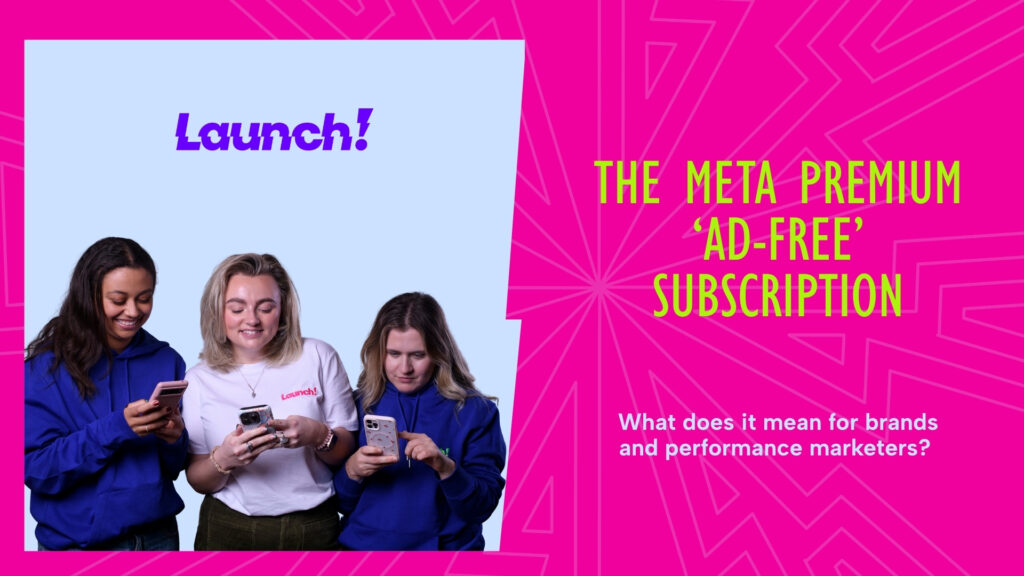
We canvassed Launch’s very own industry experts for their initial thoughts on what a Meta premium subscription service could mean, along with any advice for brands wanting to be on the front foot.
Ian Lewis, Head of Data and Analytics, Launch:
“It’s no surprise that Meta is considering a premium service. I see this as part of a bigger shift from the platform – to move away from pixel tracking to the CAPI. Meta has always talked about removing the pixel eventually. Potentially this is the first step.
“For the industry it certainly begs the question – if users become subscribers and ad personalisation is removed – what does this do for tracking conversions? Will they all fall under direct? If they are no longer seeing ads this could impact performance measurement.
“For ecommerce brands relying heavily on Meta attribution, server-side tracking (SST) isn’t optional anymore. It has become an essential part of the infrastructure.
“This move by Meta is yet another sign, if you haven’t already, to get your SST plan up and running!”
Charlie Gordon, Account Director, Launch:
“I am not entirely convinced this move by Meta is about diversifying revenue. After all, its ad business generated roughly 97% of its income last year. A few million premium subscribers won’t replace that. Surely ads are a better revenue driver than charging for no ads so it can pitch it as investment in AI?
But I’d love to see the data and insights that the trial unlocks – a breakdown of who pays for an ad-free experience by demographic i.e., age, gender and even by income. On a personal level, there’s no way I will be parting with any money just to avoid ads.”
Mike Sharp, Operations Director, Launch:
“Meta’s move into premium subscriptions shouldn’t cause panic for marketers as we have seen this play out before with YouTube Red.
“When Google launched it 11 years ago there were similar concerns about losing reach, yet today it still only accounts for about 5% of YouTube’s 2.7b users.
“Most people still prefer free access over another monthly subscription, and I would expect Meta’s adoption rates to follow a similar pattern.”
Sophie Williams, Paid Media Director, Launch:
“This move is a warning for brands and advertisers who’ve put all their eggs in the Meta basket. It should be seen as a sign of needing to diversify small budgets. Ensuring they are showing up in more places where their ideal customers can discover them both online and offline.
“After all, there’s an emerging trend where people are moving away from digital to a more analogue lifestyle. A small, but growing, percentage of people believe the internet isn’t ‘good’ for them. We may see more people actively trying to spend more time offline.”
“When it comes to cut through, advertisers need to focus more than ever on their ads being noticed, having an impact and driving action. This should be done through trying to spark emotion – whether that’s humour, admiration or peace.”
Launch has been shortlisted for the UK Agency Awards 2026, hot off the winning Performance Marketing Agency of the Year…

Most CRO efforts fail because they are trapped at the website checkout. Discover how expanding experimentation upstream into Meta ad…

Gemini has hit 1 billion users - but beyond the numbers, what does this mean for marketing leaders? Mike Sharp…